


Mai 2026 : publication Vertebrate Paleobiology and Paleoanthropology
Brain Evolution in Paranthropus
Despite the fragmentary nature of the early hominin fossil record, a handful of cranial remains offers the opportunity to provide insights into the size, shape and macroscopic organization of the brain of Paranthropus. The study of eastern and southern African specimens attributed to Paranthropus aethiopicus, Paranthropus boisei and Paranthropus robustus reveals the presence of frontal and occipital petalias, and suggests changes in the posterior parietal, anterior occipital and cerebellar regions in geologically younger Paranthropus specimens. Additionally, endocranial capacity estimates suggest there was parallel evolution of brain size in both Paranthropus and Homo. Future additions to the fossil record of Paranthropus, as well as the development of imaging and 3D modelling techniques, will certainly contribute to refine our understanding of the evolution of the brain of Paranthropus.
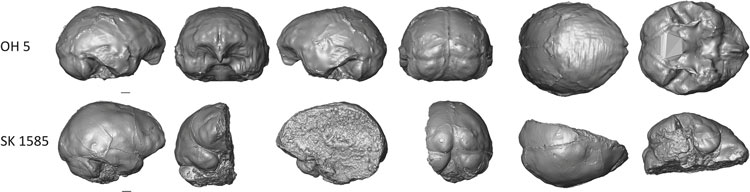
Fig. 4.3 Virtual rendering of the endocasts of the Paranthropus specimens OH 5 and of SK 1585. The virtual endocast of OH 5 is from Benazzi et al. (2011). Scale bars: 1 cm
Références
Holloway, R.L., Beaudet, A., Colby, A. (2026). Brain Evolution in Paranthropus. In: Constantino, P.J., Reed, K.E., Wood, B.A. (eds) The Forgotten Lineage(s). Vertebrate Paleobiology and Paleoanthropology. Springer, Cham. – https://doi.org/10.1007/978-3-032-05485-2_4