


Juin 2026 : publication Journal of Human Evolution
A new large-bodied sivaladapid primate from the Eocene of Myanmar resolves phylogenetic conflict obscuring the anthropoid status of Amphipithecidae
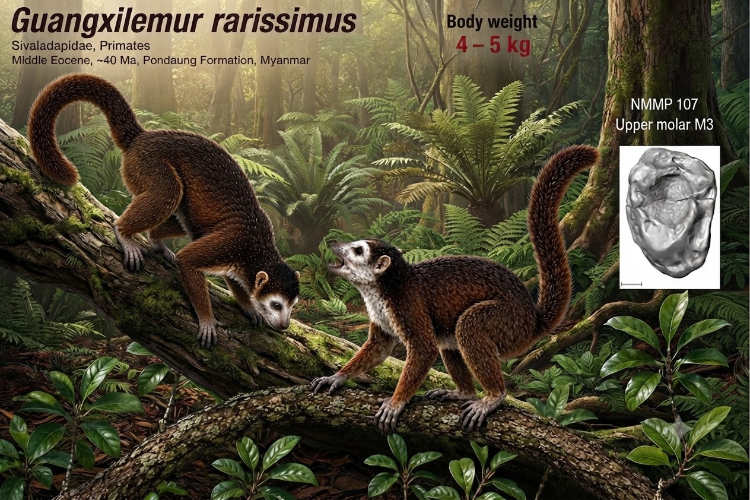
The upper middle Eocene Pondaung Formation of central Myanmar has yielded some of the earliest stem anthropoids outside Afro-Arabia. In contrast, strepsirrhine primates are rare and previously known only from the small-bodied sivaladapids Kyitchaungia takaii and Paukkaungia parva. Here we report a new large-bodied sivaladapid based on an isolated M3 from Pondaung, described as Guangxilemur rarissimus sp. nov. The tooth exhibits diagnostic features of Guangxilemur, including a subrectangular outline, a deep trigon basin, an incipient mesostyle, a well-developed buccal cingulum, and pronounced enamel wrinkling. Its dimensions indicate a body mass of approximately 4.1–4.8 kg, substantially larger than previously known Pondaung strepsirrhines and closely matching estimates for the controversial partial postcranial skeleton NMMP 20, previously attributed to the amphipithecine Pondaungia. Because NMMP 20 displays clear strepsirrhine affinities and corresponds in size to G. rarissimus, we reassign this specimen to the new taxon. This resolves the long-standing debate over the phylogenetic identity of NMMP 20 and eliminates a major source of conflict between craniodental and postcranial data, hampering previous interpretations of early anthropoid evolution in Asia. Additional material of Paukkaungia supports the recognition of greater ecological diversity among sivaladapids within the Pondaung primate community.
Références
Chaimanee, Y., Marivaux, L., Beard, K. C., Chavasseau, O., Lazzari, V., Soe, A. N., … & Jaeger, J. J. (2026). A new large-bodied sivaladapid primate from the Eocene of Myanmar resolves phylogenetic conflict obscuring the anthropoid status of Amphipithecidae. Journal of Human Evolution, 218, 103858. – DOI : 10.1016/j.jhevol.2026.103858