


Janvier 2026 : publication Archaeological and Anthropological Sciences
Towards a formation model of the Neanderthal symbolic accumulation of herbivore crania: Spatial patterns shaped by rockfall dynamics in Level 3 of Des-Cubierta Cave (Lozoya valley, Madrid, Spain)
Understanding formation processes is crucial for interpreting sites with complex sedimentary histories and exceptional archaeological records, such as Level 3 of Des-Cubierta Cave. This Middle Paleolithic unit contains an assemblage of anthropically modified ungulate horned crania, Mousterian lithics, and evidence of fire use, all preserved in a clast-supported gravel deposit shaped by successive rockfalls. This study integrates geostatistical analyses with traditional spatial and taphonomic methods to examine the cone-shaped sedimentary structure that dominates the level and its influence on the spatial distribution and preservation of archaeological materials. The results reveal distinct spatial patterns for geological and archaeological materials, indicating separate formation dynamics. Size-based spatial analyses of boulders characterize the morphology of the conical structure, highlighting size sorting and intensity variations that may indicate sedimentary hiatuses. Bone refitting analysis suggests limited post-depositional movement, with material distribution shaped by the conical sedimentary structure and karst gallery morphology. Variability in crania preservation correlates with proximity to the cone’s apex and elevation, with better-preserved specimens in central areas and more fragmented remains in zones affected by erosive and edaphic processes. These findings underscore the value of integrating geostatistical and traditional archaeological approaches to advance interpretations of spatial and temporal patterns in karst environments and provide a methodological approach for examining sites with similar sedimentary histories. Moreover, the results support the interpretation of a recurrent, culturally motivated Neanderthal behaviour centred on the deliberate accumulation of large ungulate crania, pointing to a symbolic dimension in these practices.
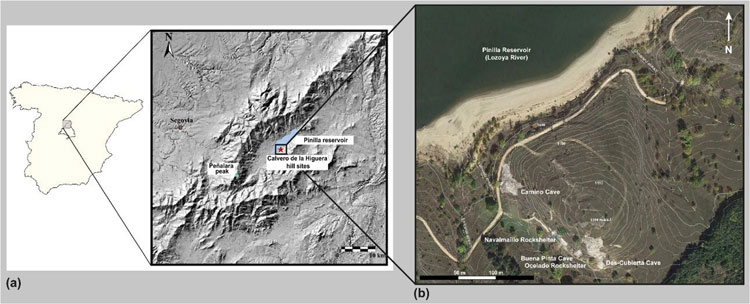
Fig. 1 – (a) Map of the Iberian Peninsula showing the location of the Upper Lozoya Valley (b) Calvero de la Higuera hill with 1 m contour lines and the location of the archaeological sites (modified from Martín-Perea et al. 2025)
Références
Villaescusa L., Baquedano E., Martín-Perea D.M., Márquez B., Galindo-Pellicena M.Á., Cobo-Sánchez L., Ortega A.I., Huguet R., Laplana, C., Ortega M.C., Gómez-Soler S., Moclán A., García N., Álvarez-Lao D.J., García-González R., Rodríguez L., Pérez-González A., Arsuaga J.L. 2026 – Towards a formation model of the Neanderthal symbolic accumulation of herbivore crania: Spatial patterns shaped by rockfall dynamics in Level 3 of Des-Cubierta Cave (Lozoya valley, Madrid, Spain) – Archaeological and Anthropological Sciences 18, 16 – https://doi.org/10.1007/s12520-025-02382-5