


27 février 2026 à 14h : séminaire international n° 78
Intervenant
Héctor Del Valle
Ph.D. Student, IPHES-CERCA & Universitat Rovira i Virgili, Departament d’Història i Història de l’Art, Avinguda de Catalunya (Tarragone, Espagne)
Thème
From Molecules to Archaeological Context: bone diagenesis applied to Stratigraphy and cultural Heritage
Bone diagenesis encompasses the physicochemical processes that modify the composition and structure of bone as a function of burial conditions. Therefore, it provides a key framework for reconstructing microenvironments and archaeological deposit formation processes. This talk presents the results of a study of the complete Pleistocene sequence of the Galería site (Sierra de Atapuerca, Burgos, Spain), using an integrated approach based on X-ray diffraction, FTIR spectroscopy, and transmission electron microscopy (TEM).
The results show the existence of common fossilization dynamics throughout the stratigraphy (units GII–GIV), dominated by dissolution–(re)precipitation processes, and identify two main diagenetic pathways: (i) a pathway toward hydroxyapatite, associated with wet, acidic, and phosphatized environments characterized by intense leaching, and (ii) a pathway toward fluorine replacement in apatite nanocrystals, characterized by the intrusion of carbonates and fluorine under drier and slightly alkaline conditions. Based on these diagenetic patterns, machine-learning classification models were developed to support the recontextualization of unprovenanced fossil bone remains.
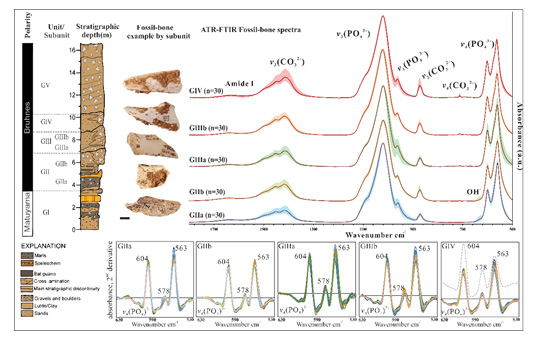
Average normalised ATR-FTIR spectra set for bone samples from each stratigraphic unit (Del Valle et al., 2025).
References : Del Valle, H.; Rodríguez-Navarro, A. B.; Moclán, A.; García-Medrano, P.; Cáceres, I. Bone Diagenesis and Stratigraphic Implications from Pleistocene Karst Systems. Sci. Rep. 2025, 15 (1), 1–16. https://doi.org/10.1038/s41598-025-88968-4.
Lieu
Salle 410, bât. B35 (3ème étage, aile nord), université de Poitiers.