


Août 2026 : publication American Journal of Biological Anthropology
Missing Landmark Estimation Using Reverse Engineering: Challenges and Potential Solutions for the Study of Hominin Long Bones
Fragmentary preservation represents a fundamental limitation in palaeoanthropological research, particularly for postcranial elements where symmetry cannot be exploited and large portions of bone are frequently missing. Although a wide range of virtual reconstruction methods exist, many rely on strong anatomical priors, localized interpolation, or reference specimens that risk biasing reconstructions toward predefined morphologies. The present study introduces a new approach for estimating the coordinates of missing landmarks, termed the Reverse Engineering (RE) approach. This method establishes mathematical relationships between morphological patterns observed in complete reference specimens and those preserved in reduced portions of each bone, allowing missing regions to be inferred from patterns of covariation rather than local geometric proximity. We demonstrate that the RE approach performs consistently across a range of reconstruction scenarios, including cases where substantial portions of bone are missing, and in empirical applications to Neanderthal femoral and humeral specimens. Importantly, reconstructed specimens retain morphological signal in subsequent morphometric analyses, regardless of the extent of missing data. While limitations remain, as is the case for all reconstruction methods applied to fragmentary fossil material, the RE approach offers a robust and flexible alternative that does not depend on symmetry or a single reference specimen. As such, it represents a valuable addition to the methodological repertoire available to palaeoanthropologists working with incomplete postcranial remains.
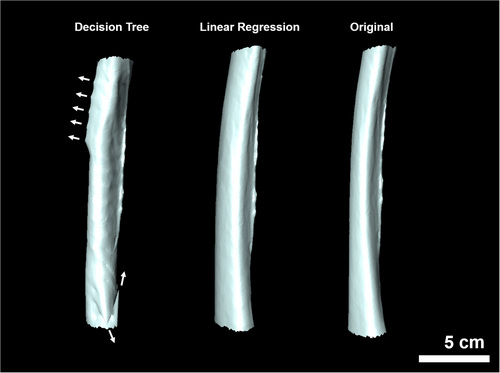
Figure 5. Typical imperfections identified in the reconstructed femoral shaft of a modern human individual using decision tree regression models, in comparison with reptile metalearning-trained neural networks. Arrows indicate where landmarks have displaced considerably from the rest of the landmark configuration, identifying the need to use regression algorithms that are able to model the spatial relationship between the predicted landmarks.
Références
Courtenay, L. A., & Aramendi, J. (2026). Missing Landmark Estimation Using Reverse Engineering: Challenges and Potential Solutions for the Study of Hominin Long Bones. American Journal of Biological Anthropology, 190(4), e70334 – DOI: 10.1002/ajpa.70334