


Janvier 2026 : publication Journal of Anatomy
Does ulnar curvature covary with locomotion and substrate use in cercopithecids?
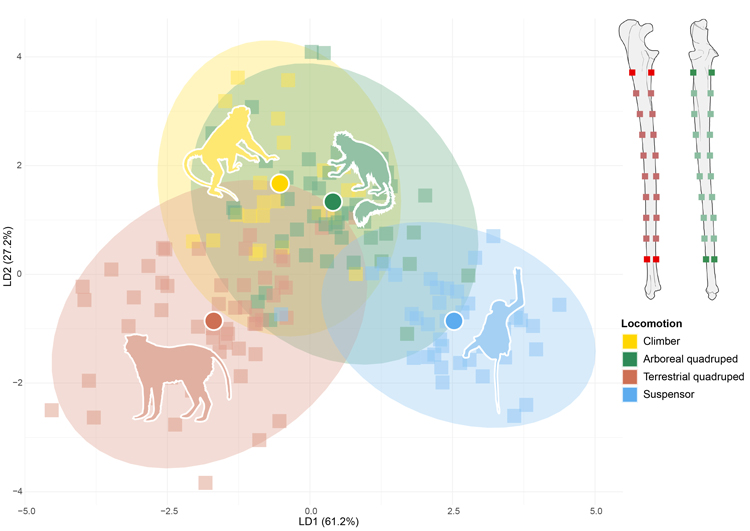
Ulnar curvature has long been recognized as an indicator of locomotor behavior in mammals, although its relevance has yet to be thoroughly tested in a phylogenetically restricted and functionally diverse group. Extant cercopithecids exhibit a wide range of quadrupedal locomotor behaviors and substrate use, making them an ideal benchmark to test form-function relationships between ulnar curvature and locomotion. While their ulnar curvature has been partly investigated through its anteroposterior curvature, the mediolateral curvature remains largely unexplored. We hypothesized that ulnar curvature covary with habitual substrate use (i.e., terrestrial versus arboreal) and locomotor behaviors (e.g., suspension versus climbing) in both sagittal and coronal planes. In this study, we provide a comprehensive assessment of ulnar curvature in extant cercopithecids, based on an extensive and taxonomically diverse sample of 23 species and 167 individuals, to assess inter- and intraspecific morphological variation. As expected, our analyses confirm previous findings regarding anteroposterior curvature, with terrestrial quadrupeds exhibiting an anteriorly convex ulna, and arboreal taxa showing an anteriorly concave ulna. Regarding mediolateral curvature, arboreal taxa exhibit a lateral convexity, while terrestrial quadrupeds show a more complex sigmoid curvature, possibly reflecting resistance to the various mediolateral constraints generated by hand postures. Although the two curvatures seem to distinguish arboreal and terrestrial locomotor behaviors, their moderate covariation (~55%) suggests that curvature responds to partially distinct biomechanical factors. Suspensory taxa, previously thought to possess relatively straight ulnae, are revealed to have noticeable anteriorly concave bones, consistent with notable brachialis contraction during suspension. Unexpectedly, climbers show intermediate morphologies between arboreal and terrestrial quadrupeds, supporting the idea that ulnar curvature does not allow their distinction, implying that this behavior is difficult to infer through ulnar curvatures.
Références
Pappalardo N., Pallas L., Karoui-Canedo J., Guy F., Daver G. 2025 – Does ulnar curvature covary with locomotion and substrate use in cercopithecids? – Journal of Anatomy, 00:1-18 – Doi.org/10.1111/joa.70091