


Janvier 2026 : publication Papers in Palaeontology
Freshwater amphibians and squamates from Villeveyrac (lower Campanian, Hérault, France): palaeodiversity, palaeoenvironment and implications for the Late Cretaceous palaeobiogeography of European herpetofauna.
The Late Cretaceous witnessed numerous transgression–regression sequences and the onset of a global cooling phase at the start of the Campanian. In the European archipelago, these environmental changes, combined with active plate tectonics, facilitated the formation of ephemeral land bridges that served as dispersal routes for a variety of clades. However, the timing and mechanisms of these dispersals remain poorly understood, notably because of the scarcity of lower Campanian fossil-bearing continental outcrops. Over the last two decades, the locality of Villeveyrac (Hérault, France) has yielded lower Campanian freshwater deposits, particularly rich in vertebrates and plants. Despite abundant findings, the diversity of amphibians and squamates has been sparsely documented. In this study we identify six amphibian taxa (Albanerpetontidae, ?Palaeobatrachidae indet., ?Neobatrachia indet., Batrachosauroididae indet., and two indeterminate anurans) alongside six squamate taxa, which include a pan-shinisaur lizard, a madtsoiid snake of the genus Herensugea and indeterminate monstersaur, ?anguid, iguanomorph and squamate. Six of these 12 taxa, specifically the palaeobatrachid, batrachosauroidid, pan-shinisaur, madtsoiid, monstersaur and iguanomorph, correspond to the earliest occurrence of their clades in Europe. Additionally, we tentatively document one of the oldest anguids in the world. For each of these groups, we discuss palaeobiogeographical and palaeoenvironmental implications. The amphibian and squamate composition highlights a combination of aquatic, semi-aquatic and terrestrial features, consistent with other animal and plant remains. The lower Campanian deposits of Villeveyrac are thus interpreted as a floodplain with braided streams, river channels, and surrounding riparian and paludal habitats, under a warm and humid subtropical climate.
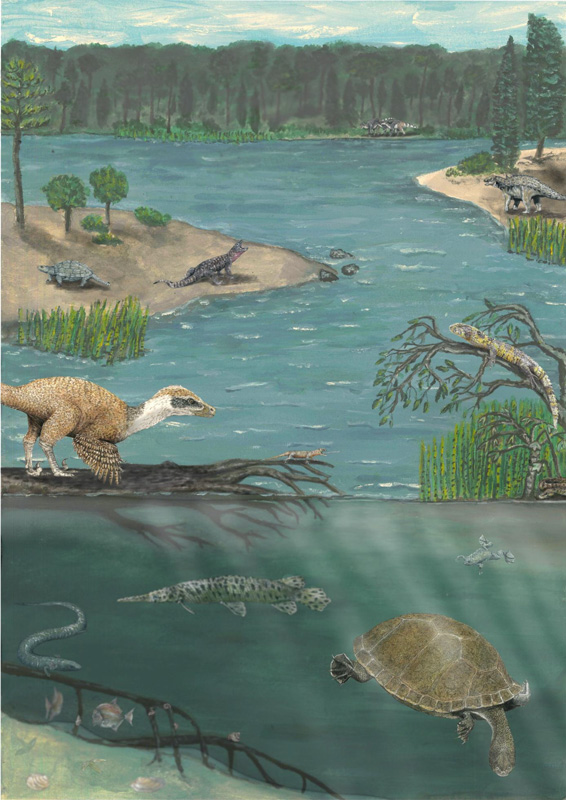
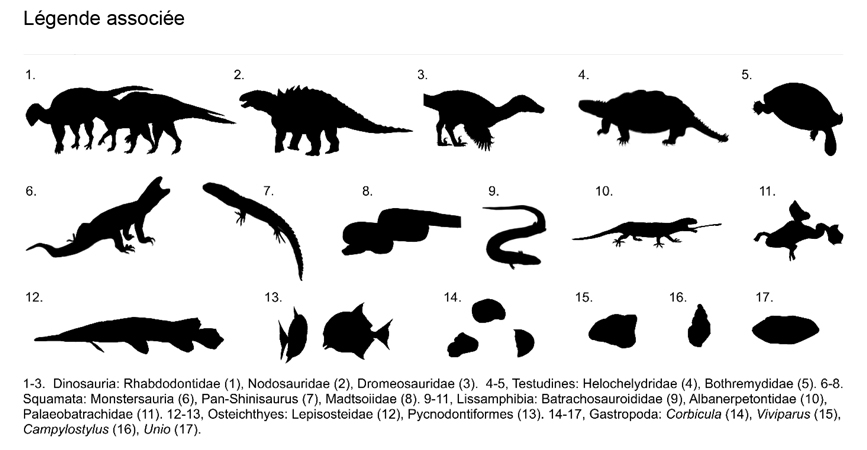
Reconstruction of this rich Late Cretaceous floodplain ecosystem (~80 million years ago) from Villeveyrac comprising several emblematic taxa in the various links of this food web. (Copyright O. Jansen & X. Valentin 2026)
Références
Jansen O., Garcia G., Otero O., Augé M., Gomez B., Valentin X. 2026 – Freshwater amphibians and squamates from Villeveyrac (lower Campanian, Hérault, France): palaeodiversity, palaeoenvironment and implications for the Late Cretaceous palaeobiogeography of European herpetofauna – Palaeontology: 12, 1, e70055 – DOI: 10.1002/spp2.70055
En savoir plus
- Communiqué de presse de l’université de Poitiers : https://www.univ-poitiers.fr/lactu-des-labos-decouverte-de-nouveaux-amphibiens-et-squamates-a-lombre-des-dinosaures/