


December 2025: publication Gebios
The early Oligocene Caniformia (Carnivora, Mammalia) from the standard level MP23 in the ‘Phosphorites du Quercy’, Occitanie, southwestern France
This article describes Caniformia carnivorans newly found in southwestern France fossiliferous localities called ‘Phosphorites du Quercy’ and dated to the MP biochronological scale standard level MP23 (reference locality: Itardies, 30.56 ± 0.18 Ma; early Oligocene). In Europe, the Eocene-Oligocene transition is marked by a significant paleobiological turnover known as Stehlin’s ‘Grande Coupure’, representing a major shift in the evolutionary history of Caniformia. Before the ‘Grande Coupure’, a nearly singular, small and primitive Amphicyonidae was present in the late Eocene of Europe, while a wide diversity of taxa and morphologies emerged by the early Oligocene. When compared to the material from the 19th century ‘Old Collections from the Quercy’, the well-dated new material provides biochronological information to species first described without any time constraint, thus precising their position in the evolutionary process. We describe the most primitive musteloid taxon ever found in Europe. Other Caniformia taxa show ecological niches absolutely unknown in extant faunas, with horizontal wear facets in the check teeth. The most abundant taxon shows adaptations to climbing; the high diversity of small carnivores and glirid rodents supports the hypothesis of an at least partially forested environment. The high number of individuals including juveniles of species of amphicynodontids favours the hypothesis of individuals buried in their den and suggests a potential gregarious behaviour.
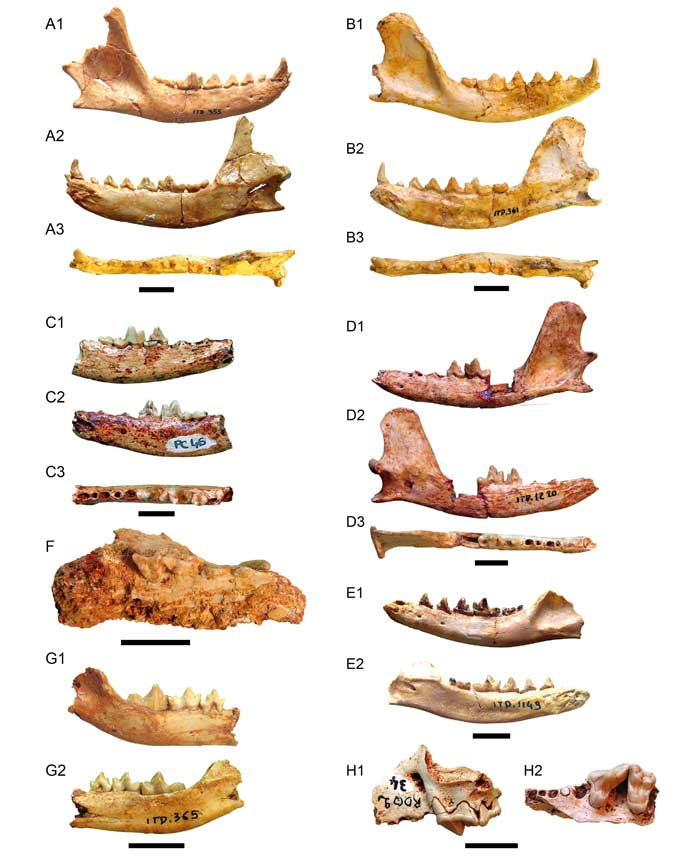
Fig. 3. A, B, F, G. Amphicynodon leptorynchus. A: right hemimandible, c-m3, ITD355, in buccal (1), lingual (2) and occlusal (3) views; B: right hemimandible, c-m2, ITD361, in buccal (1), lingual (2) and occlusal (3) views; F: juvenile left maxilla, D1-D4, ITD1180, occlusal view; G: Right hemimandible, d3-d4-m1, ITD365, in buccal (1) and lingual (2) views. C, D. Amphicynodon typicus. C: right hemimandible, p3-m2, PC46 (holotype), in buccal (1), lingual (2) and occlusal (3) views; D: left hemimandible, p4-m1, ITD1220, in buccal (1), lingual (2) and occlusal (3) views. E. Amphicynodon gracilis, hemimandible, p2-m3, ITD1149, in buccal (1) and lingual (2) views. H. Amphicynodon sp., left maxilla, P4-M2, ROQ34, in buccal (1) and occlusal (2) views. Scale bars: 1 cm.
References
De Bonis L., Gardin A., Escarguel Gilles 2025 – The early Oligocene Caniformia (Carnivora, Mammalia) from the standard level MP23 in the ‘Phosphorites du Quercy’, Occitanie, southwestern France – Geobios 93, 1-22 – Doi.org/10.1016/j.geobios.2025.07.001