


February 2026: publication Peer Community of Paleontology
New associated postcranial remains from the Shungura Formation (Lower Omo Valley, Ethiopia) provide insights on behaviors and ecology of early Homo
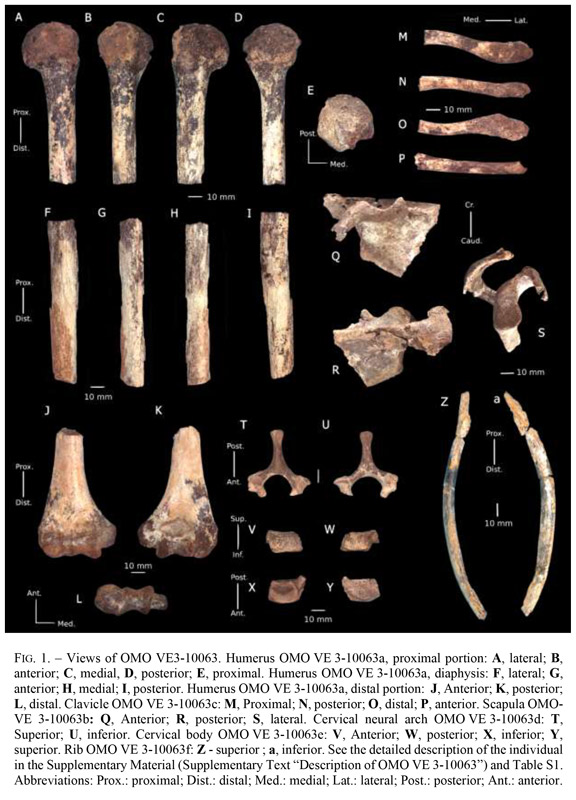
The genus Homo Linnaeus, 1758 is hypothesized to have ecologically diverged from australopiths (Australopithecus Dart, 1925 and Paranthropus Broom, 1938) between 2.8 Ma and 1.9 Ma. Compared to australopiths, the behavioral repertoire of Homo would be characterized by a significant reduction or complete absence of arboreal locomotion, long-distance walking and endurance running, and an increase of dexterous activities (throwing, manipulation, load carrying). However, testing these two last hypotheses has been largely constrained by the scarcity of associated fossil remains with varying preservation and different ontogenetic stages. This study presents new adult postcranial remains assigned to a single individual OMO VE 3-10063 from the Shungura Formation (Lower Omo Valley, Ethiopia) and dated to about 1.84 Ma. These remains comprise a subcomplete shoulder and arm, and two vertebral and one rib fragments. Comparative analyses with extant non-human apes, extant humans and Plio Pleistocene hominins using linear and angular measurements, and geometric morphometrics indicate that OMO VE 3-10063 is taxonomically and functionally closer to Homo than to australopiths. It makes this shoulder complex the oldest and best-preserved reliably assigned to this genus. This partial skeleton indicates that Homo had already reduced functions of the forelimb related to arboreal locomotion as early as 1.8 Ma, notably with a glenoid surface of the scapula less cranially-oriented than in African apes, an elbow with a shallow trochlear notch, and a clavicle suggesting that loads applied on the forelimb of the individual were similar to those of extant humans. Furthermore, we propose that the morphology observed in OMO VE 3-10063 is consistent with habitual terrestrial bipedalism and increased dexterous activities relative to australopiths.
References
Blasi-Toccacceli A., Daver G., Brusse T., Jashashvili T., Voisin J.L., Pallas L., Domalain M., Surault J., Redae B.E., and Boisserie J.R. 2026 – New associated postcranial remains from the Shungura Formation (Lower Omo Valley, Ethiopia) provide insights on behaviors and ecology of early Homo – PaleorXiv r3jcy, ver. 6 peer-reviewed by PCI Paleo. – https://dx.doi.org/10.31233/osf.io/r3jcy_v6