


March 2026: publication Comptes rendus palevol
Virtual reconstruction and comparative study of the face of StW 573 (“Little Foot”)
Besides being taxonomically and phylogenetically informative, changes in the size and shape of the hominin face through time can reflect important functional adaptations. Recent discoveries of well-preserved Australopithecus crania, particularly StW 573 (“Little Foot”) from Sterkfontein, South Africa, have enriched the fossil record. Although nearly complete, the StW 573 skull has suffered post-depositional damage, leading to the displacement and fragmentation of its facial structures. This study presents a preliminary digital reconstruction and comparative analyses of the StW 573 face. The skull was scanned at the Diamond Light Source (United Kingdom), and semi-automated segmentation was used to digitally separate bones and teeth from the surrounding matrix, and isolate bone fragments. The fragments were then digitally reassembled through visual alignment. The reconstructed StW 573 face was compared to those of Gorilla, Homo, Pan, and Pongo, and to the Australopithecus specimens Sts 5 (Australopithecus africanus from South Africa, 3.4-3.5 Ma) and A.L. 444-2 (Australopithecus afarensis from Ethiopia, 3.8 Ma), using standard linear measurements and a landmark-based geometric morphometric (GM) approach. The dimensions of the StW 573 reconstructed face, as assessed by the linear measurements, fall within the ranges observed in Gorilla and Pongo. Our GM analysis reveals that the shape of the reconstructed face of StW 573 is more similar to A.L. 444-2 than to Sts 5, with both fossils plotting close to extant Pan and Pongo groups in shape space. In addition to documenting close similarities between StW 573 and the eastern African Australopithecus specimen A.L. 444-2, our results provide new insights into the variability of the Australopithecus facial skeleton and raise questions on the adaptations and evolutionary polarity (e.g. ancestral pattern shared between eastern and southern African Pliocene Australopithecus) underlying changes affecting the orbital region within the genus.
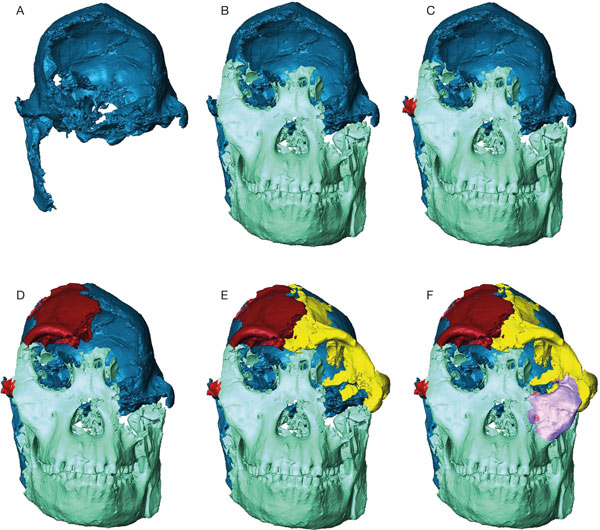
Fig. 2. — Reconstruction of the face of StW 573. The braincase and right ramus in blue (A) are aligned with the maxilla and the rest of the mandible in green (B). The portion of the right zygomatic arch in red is refitted to the temporal and zygomatic bones (C). The right frontal bone in dark red is positioned to fit with the maxilla (D). The left frontal bone and zygomatic in yellow (E) is repositioned to fit with the other blocks. The intact right maxilla is mirrored to reconstruct the left maxilla in purple (F). Credits: A. Beaudet.
References
Beaudet A., Dupont E., Guy F., Dumoncel J., Atwood R., Fernandez V., Vo N. T., Clarke R., Heaton J. L., Pickering T. R., Carlson K. J., Subsol G. & Stratford D. 2026 – Virtual reconstruction and comparative study of the face of StW 573 (“Little Foot”), in Hublin J.-J., Mounier A. & Teyssandier N. (eds), Lucy’s Heirs -Tribute to Yves Coppens – Comptes Rendus Palevol 25 (3): 43-56 – https://doi.org/10.5852/cr-palevol2026v25a3
Find out more
- Press release CNRS : https://www.cnrs.fr/en/press/first-digital-reconstruction-face-little-foot