


February 2026: publication Journal of Paleontology
Modern anatomy meets ancient bones: How virtual anatomy is transforming palaeoanthropological research
Palaeoanthropology is highly dependent on anatomical knowledge. Anatomical descriptions and comparisons have long formed the basis of the discipline, allowing researchers to draw inferences about our ancestors’ behaviour, biology, and locomotion, as well as to establish phylogenetic relationships between extinct hominins and define taxa within the fossil record. The integration of virtual anatomy methods, relying on high-resolution imaging, 3D modelling, and computational simulations, has revolutionised the field, enabling palaeoanthropologists to quantify anatomical variation, simulate biological processes, and reconstruct morphology in fossil material with unprecedented precision. In a field limited not only by the sole preservation of hard mineralised tissues such as bone and teeth, but also by their fragmentary condition and frequent geological or taphonomic distortion, the introduction of methods that allow analytical procedures to be shared, repeated, and performed non-destructively has greatly enhanced anatomical studies of extinct hominins. Moreover, despite the lack of direct evidence for soft tissues, the adaptive properties of bone, shaped by the muscles, tendons, and organs surrounding it and the forces they exert, now allow palaeoanthropologists to reconstruct muscle attachment sites, brain morphology, and other soft tissue-related structures. Researchers can also simulate bone responses to activities such as bipedal locomotion or tool use through static and dynamic modelling that enables them to virtually construct ‘what-if’ scenarios, effectively bringing to life some of the most iconic specimens in human evolution. Despite these advances, the field still has a long way to go. The recent introduction of AI algorithms to automate specific preprocessing phases (e.g., segmentation), alongside the ongoing need for methodological integration and broader access to technological resources, highlights the importance of developing a more open, replicable, and globally accessible toolkit for palaeoanthropologists worldwide.
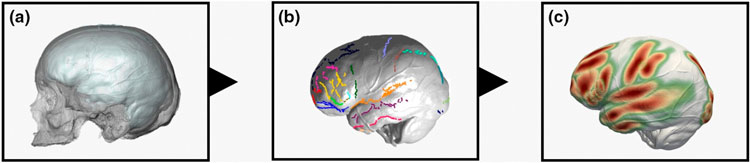
Fig. 2 – Typical pipeline for creating density maps of sulcal imprints on endocasts. (a) Automatic segmentation of a digital endocastfrom the cranium. (b) Automatic detection of sulcal imprints on the endocast. (c) Creation of the average endocast and correspondingdensity maps of sulcal imprints of the entire sample.
References
Aramandi J., De Jager E. 2026 – Modern anatomy meets ancient bones: How virtual anatomy is transforming palaeoanthropological research – Journal of Anatomy. 00:1–12 – DOI: 10.1111/joa.70119