


May 26 2026 – 10:30am: international seminar Palevoprim n° 81
Speaker
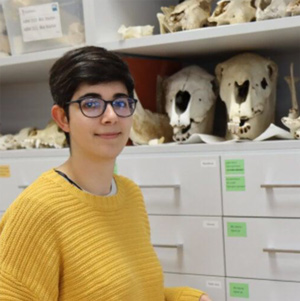
Leire Torres-Iglesias
Marie Skłodowska-Curie postdoctoral researcher, University of Copenhagen
Topic
Integrating palaeoproteomics and archaeozoology to evaluate human subsistence behaviour during the Late Pleistocene
Faunal skeletal remains are among the most abundant and best-preserved materials in Pleistocene contexts and provide valuable data for reconstructing paleoecologies and various aspects of hominin behaviour, including hunting strategies, carcass processing, and mobility patterns. However, the high fragmentation of Pleistocene faunal assemblages usually makes taxonomic identification and sex estimation difficult, thereby losing key information for reconstructing past environments and human socioeconomic dynamics.
In this sense, the application of biomolecular analyses, such as aDNA and ancient protein analyses, can help to overcome some of the limitations of traditional archaeozoological and palaeontological methods. Specifically, the study of proteins preserved in fossil bones and teeth has, over the last decade, become an important tool for improving our understanding of human evolution and the way of life of prehistoric societies. The study of proteins, such as collagen and amelogenin, allows us to taxonomically identify unidentifiable fossil remains, estimate biological sex and assess the phylogenetic relationships between different species.
In this talk, we will discuss how applying a multidisciplinary approach, integrating paleoproteomics, archaeozoology, and taphonomy, to the study of faunal remains provides new insights to disentangle human-prey-environment interactions during the Late Pleistocene with higher resolution.
Place
Room 410, 3rd floor, North wing, Build. B35, University of Poitiers.