


June 2026: publication Scientific Reports
New fossil evidence from the Late Cretaceous of Europe (southern France) deepens the origin of Salamandridae (Urodela) and refines the biogeography of the family
Salamandrids are today the most diverse family of salamanders of the Palearctic, including 146 species and 22 genera. The oldest fossil occurrences of the group are so far dated to the Paleocene (around 60 Myr ago), except for an isolated vertebra in the late Maastrichtian of Spain, although molecular studies place the origin of the group earlier, in the Late Cretaceous. New findings from the Upper Cretaceous of France fill this stratigraphic gap, significantly predating the previous oldest fossil occurrence of the group by 10 Ma. The material includes isolated vertebrae from four localities with an age spanning from the late Campanian to the late Maastrichtian, which can be straight-forwardly attributed to Salamandridae thanks to the type of ossification of the anterior condyle. The material from Les Pennes-Mirabeau and La Neuve can be referred to Koalliella sp., which was found in Paleocene deposits of other European localities. The same referral is only tentative in the case of the other two localities (Vérane, Champ-Garimond), due to their uncompleteness. New divergence timings for salamandrids are estimated based on the new stratigraphic ranges and on the recently recovered phylogenetic position of early salamandrids. Our data strongly support a European origin of salamandrids and biogeographic implications are discussed by combining the current distributions, the fossil record, and the new timing divergence estimates. Our results notably strengthen previous biogeographic hypothesis based on the Cenozoic record, supporting three dispersal events from Europe: the North American Notophthalmus and Taricha clades colonised the Nearctic before the Oligocene through Beringia, whereas the two clades of crocodile newts (Echinotriton and Tylototriton) and the modern Asian newts (e.g. Cynops) likely reached Southeastern Asia during the Oligocene. The regression of the Turgai Sea at the end of the Eocene is herein suggested as the main geographical driver of the dispersal events.
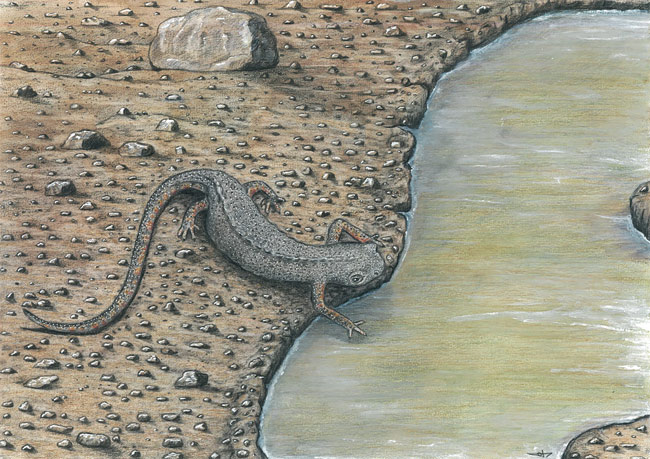
Illustration of the salamandrid Koalliella sp. from the Campanian-Maastrichtian of France poised toswim in a water-filled ankylosaur footprint. Original artwork by Olivier Jansen.
References
Macaluso, L., Jansen, O., Valentin, X. et al. New fossil evidence from the Late Cretaceous of Europe (southern France) deepens the origin of Salamandridae (Urodela) and refines the biogeography of the family. Sci Rep 16, 16567 – DOI : 10.1038/s41598-026-44690-3.