


July 3 2026 – 2 pm: international seminar n° 83
Speaker
Miksha Harripershad
Postdoctoranl researcher, University of Pretoria, South Africa
Topic
Exploring skeletal variation in contemporary human populations: focus on South Africa
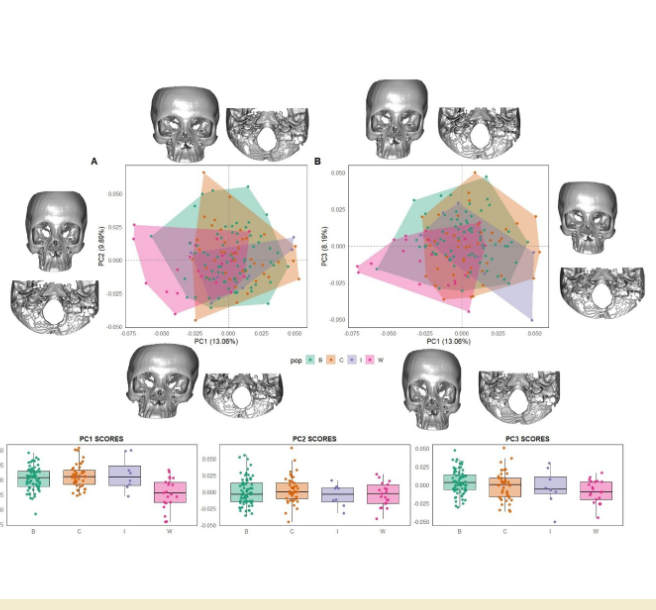
My research focuses on understanding patterns of human skeletal variation in South African populations and their application within biological and forensic anthropology. Broadly, my work examines how factors such as growth, development, biological stress, and population history influence cranial morphology and contribute to variation within and between populations.
A major component of this research explores the relationship between skeletal variation and developmental processes, including the study of cranial asymmetry and non-specific indicators of physiological stress (e.g., cribra orbitalia, porotic hyperostosis or linear enamel hypoplasia). The study investigated whether individuals exhibiting evidence of developmental stress also displayed increased levels of fluctuating asymmetry. As well as how fluctuating asymmetry was expressed between population groups and sexes. These features provide valuable insights into the biological and environmental factors that shape human skeletal variation throughout life.
My work also investigates skeletal variation in South African subadults, with particular emphasis on when population-related differences emerge during growth and development and how these patterns can be identified using cranial morphology. This research contributes to broader discussions surrounding human variation and the application of skeletal analyses in forensic contexts.
In parallel, I am interested in the use of virtual anthropology and advanced imaging techniques in skeletal research. With methods such as cone-beam computed tomography (CBCT), micro-computed X-ray tomography (micro-XCT), or surface scanning, part of my research examines how virtual approaches can enhance the analysis of skeletal remains, notably for palaeopathological studies.
Together, my research aims to contribute to a broader understanding of human skeletal variation and highlight the value of integrating traditional osteological methods with digital technologies in biological and forensic anthropology.
Place
Room 410, 3rd floor, North wing, Build. B35, University of Poitiers.