


October 2026 : publication Scientific Reports
First evidence of air-breathing in a fossil polypterid
This study is the result of a collaboration between Brazil, Chad and France. It presents the first evidence of air-breathing in a fossil polypterid, †Polypterus faraou, from the Miocene of Chad, using CT-scan 3D imaging. The †P. faraou specimen preserves open spiracles with associated bones functioning as air valves. It also retains features of the buccal pump mechanism, including a combination of a broad palate region, an elongated parasphenoid, and a mobile hyoid arch, all indicative of air-breathing capability. The arrangement of overlapping peg-and-socket scales suggests the potential for scale-mediated aspiration, akin to that of modern polypterids. These findings strongly support the hypothesis that †P. faraou employed both buccal pumping and recoil aspiration for lung ventilation. We recognize that the characters analysed here not only support the buccal pump mechanism but also contribute to prey capture. This study provides the first evidence of air-breathing in fossil polypterids, as well as in fossil actinopterygians, highlighting the relevance of polypterids for investigating the evolution of aerial respiration in vertebrates.
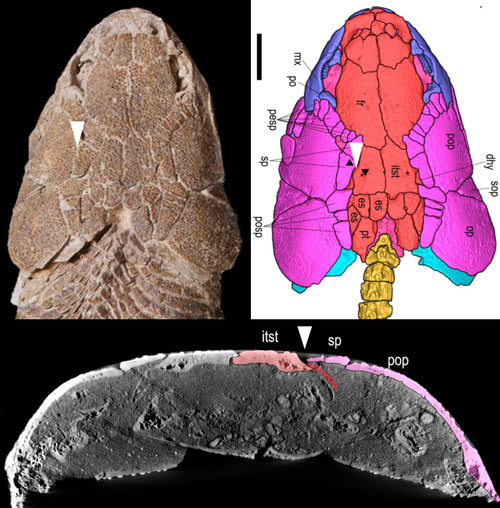
Fig. 1 : Three-dimensional reconstruction of the dorsal view of the skull, showing the spiracular bone series (pesp, sp, posp) in (A) the fossil specimen †P. faraou TM090-001–039 and (B) the extant specimen P. bichir MNHN-IC-1907-0250. Transverse section of the tomography of (C) †P. faraou and (D) P. bichir, where dark red represents the space of the spiracle in the extant specimen and its inferred location in the fossil specimen. Arrow heads indicate spiracular openings on both threedimensional reconstructions (black) and transverse sections of the tomographies (white). Osteological abbreviations: dhy, dermohyal; dsp, dermosphenotic; es, extrascapular; fr, frontal; itst, intertemporo supratemporal; mx, naxilla op, opercle; pesp, prespiracular bones; po, postorbital; pop, preopercle; posp, postspiracular bones; sop, subopercle; sp, spiracular bones. Scale: A = 2 cm; B = 1 cm.
References
Coelho, M.V., de Mayrinck, D., Likius, A. et al. First evidence of air-breathing in a fossil polypterid. Sci Rep (2026) – https://doi.org/10.1038/s41598-026-68911-x